

Advanced Risk Appetite Index
Educational Overview
Defensive portfolio strategy prioritizing capital preservation over maximum returns. Systematic crisis detection, dynamic position sizing, and superior risk-adjusted performance for conservative investors.
Defensive Investment Strategy
The Advanced Risk Appetite Index (ARAI) represents a defensive investment strategy designed for capital preservation and risk reduction. Rather than maximizing returns, ARAI focuses on protecting capital during market downturns while participating in market uptrends when conditions are favorable.
This conservative approach employs systematic position management, spending only 61% of time in the market and maintaining cash positions during uncertain periods. With 24% lower volatility than the S&P 500, ARAI offers a smoother investment experience with reduced portfolio stress and emotional decision-making.
The strategy has demonstrated consistent performance over 45 years since 1980, achieving a 68.4% win rate while avoiding the worst market crashes. During major crisis periods like 2008 and 2020, ARAI's defensive positioning helped preserve capital when traditional buy-and-hold strategies suffered significant losses.
Historical Performance
Cumulative returns from 1980 to 2025 (backtested)
Past performance does not guarantee future results. For educational purposes only.
Performance by Year
Detailed breakdown of yearly returns showing consistency and long-term capital preservation
Positive Years
Profitable trading years
Best Year
Highest annual return
Worst Year
Lowest annual return
Annual Returns Overview
Year-by-Year Performance
Returns calculated from cumulative performance data. All figures are net of costs and represent backtested results.
Why ARAI Works
Five key advantages that make ARAI effective for capital preservation and risk-conscious investors
Exceptional Profit Factor
Gross Profit / Gross Loss
For every dollar lost, ARAI generates $3.92 in profit. This exceptional ratio demonstrates systematic edge through disciplined risk management and selective market participation.
Superior Drawdown Protection
Maximum Drawdown vs. S&P 500: -56.8%
ARAI's maximum drawdown of -33.9% compares favorably to the S&P 500's worst drawdown of -56.8% during 2008-2009. Preserving capital during crashes is crucial for long-term wealth building.
Psychological Advantage
Lower Volatility Than S&P 500
Smoother equity curves mean less portfolio stress and fewer emotional decisions. Investors who can stick to their strategy perform better. ARAI's reduced volatility makes it easier to maintain discipline during market turbulence.
Tail Risk Protection
Largest Single Loss (2008 Crisis)
During the 2008 financial crisis, ARAI's worst single position loss was -10.3%. Systematic crisis detection helped avoid catastrophic losses when markets collapsed by over 50%.
Cash Reserve Strategy
Time in Market vs. 100% Invested
Only 61% market exposure means 39% cash availability. This provides downside protection during crashes and liquidity for opportunities. Missing the worst days matters more than catching every up day.
Dynamic Position Sizing
Adaptive Capital Allocation
ARAI calculates optimal position size in percentage terms based on market conditions. Higher risk appetite = larger positions (up to 97.8% of capital). Lower risk appetite = reduced exposure or cash. This dynamic approach maximizes returns during favorable periods while protecting capital during uncertainty.
Core Framework
Three pillars of defensive portfolio management combining capital preservation, crisis detection, and systematic risk control
Scientific Foundation
Built on peer-reviewed research in behavioral finance, market microstructure, and systemic risk measurement.
- Multi-factor analysis framework
- Behavioral finance integration
- Market microstructure theory
- Academic research validation
Professional Implementation
Institutional-grade risk assessment with sophisticated algorithms and real-time processing capabilities.
- Proprietary calculation engine
- TradingView integration
- Real-time risk monitoring
- Professional documentation
Practical Applications
Complete risk management system with dynamic position sizing for adaptive portfolio control.
- Dynamic position sizing (88%-97.8% range)
- Real-time crisis detection signals
- Systematic entry/exit timing
- Market regime classification
Methodology & Applications
Understanding how ARAI transforms complex market data into actionable risk intelligence
Technical Approach
Multi-Factor Analysis
ARAI synthesizes risk signals across equity markets, credit conditions, currency dynamics, and commodity trends through proprietary weighting algorithms that adapt to changing market conditions.
Regime Detection
Advanced statistical processing identifies distinct market regimes including crisis periods, risk-on environments, defensive positioning, and neutral conditions with mixed signals.
Quality Control
Comprehensive filtering mechanisms ensure signal reliability through data validation, cross-component consistency checks, and outlier detection during market disruptions.
Practical Usage
Portfolio Management
Strategic asset allocation decisions, tactical positioning adjustments, and dynamic rebalancing timing based on comprehensive risk appetite assessment.
Crisis Detection
Early warning system for regime transitions and market stress conditions, enabling proactive defensive positioning before major dislocations.
Dynamic Position Sizing
ARAI's core strength: automatically calculates position size as a percentage of capital (88%-97.8% in risk-on, 0% in risk-off). This adaptive sizing maximizes participation during favorable conditions while preserving capital during uncertainty. The indicator displays exact allocation percentages for precise portfolio implementation.
Real-World Crisis Detection
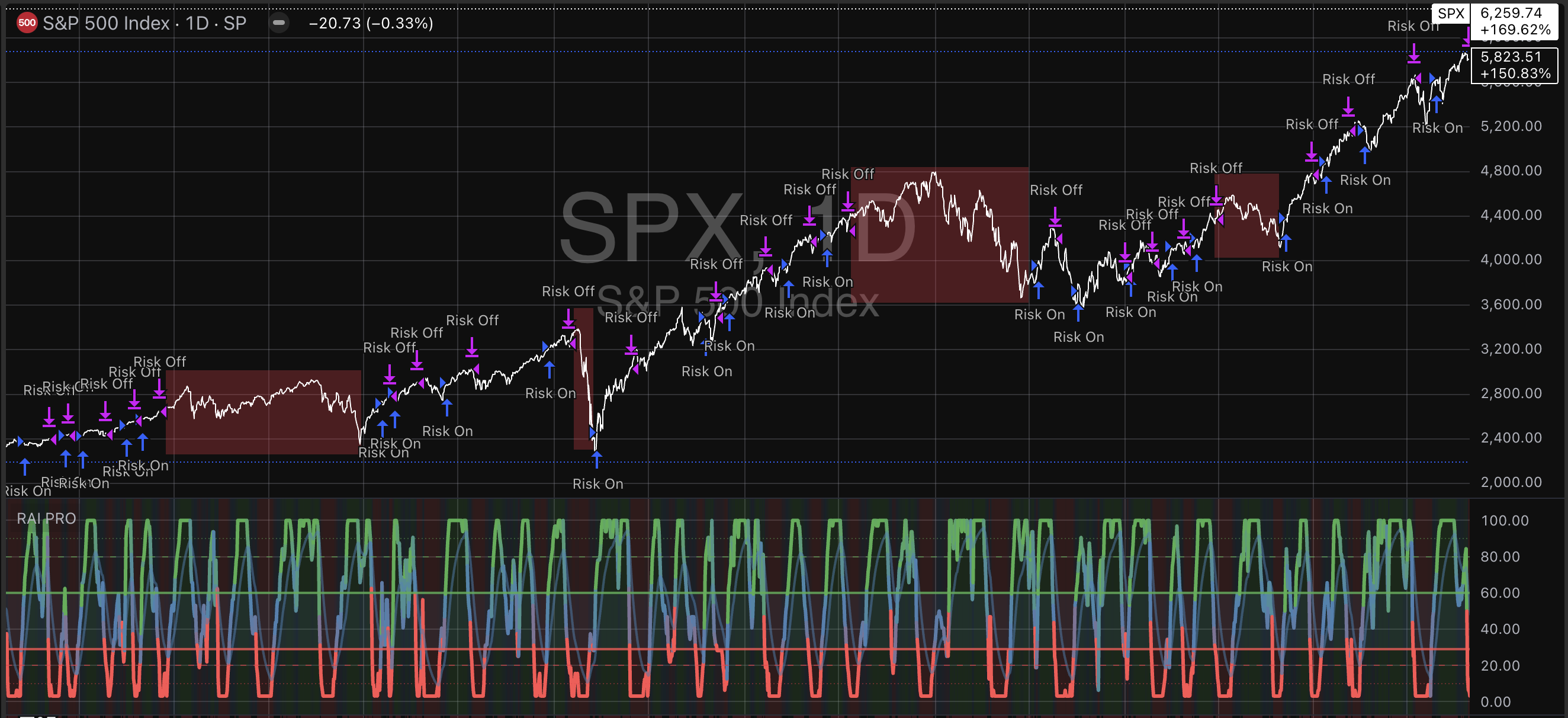
ARAI's defensive positioning and crisis detection capabilities demonstrate effective capital preservation during major market crashes and volatile periods
ARAI Position Management: S&P 500 Performance During Market Crises
Crisis Periods
Red shaded areas mark major market crises where ARAI enabled defensive positioning or complete hedging, avoiding major losses
Position Entry
Blue arrows indicate ARAI signals for position opening when risk appetite increases and market conditions improve
Position Exit
Purple arrows show ARAI signals for position closing when risk appetite declines, protecting portfolio from upcoming downturns
Empirical Results
Performance metrics showcasing ARAI's effectiveness as a defensive strategy for capital preservation and risk reduction
Win Rate
Percentage of profitable trading positions
Volatility Reduction
Lower volatility compared to S&P 500
Risk-Reward Ratio
Average gain per trade vs. average loss
years
Validated across multiple market cycles since 1980
Risk-Adjusted Performance Analysis
Historical Statistics
Risk Management
Important: Performance metrics based on historical S&P 500 analysis from 1980-2025. ARAI is designed as a defensive strategy prioritizing capital preservation over maximum returns. Results reflect systematic application of defensive positioning under controlled backtesting conditions. Past performance does not guarantee future results.
Research Background
ARAI builds upon decades of peer-reviewed research in behavioral finance and market microstructure
The theoretical foundation rests on seminal works by Baker & Wurgler (2006) on investor sentiment, Campbell & Cochrane (1999) on habit formation in consumption, and Shiller (2000) on market psychology. These studies demonstrate the cyclical nature of risk appetite and its measurable impact on asset prices.
Recent advances by Tetlock (2007) and Stambaugh, Yu & Yuan (2012) provide empirical frameworks for quantifying sentiment effects, while Huang et al. (2015) demonstrate the predictive power of aligned sentiment measures for stock returns.
ARAI synthesizes these research streams into a practical framework that maintains academic rigor while providing actionable insights for professional portfolio management and systematic trading strategies.
Ready to Protect Your Capital?
Get ARAI Professional with dynamic position sizing, real-time crisis detection, and systematic risk management. Built for investors prioritizing capital preservation, lower volatility, and superior risk-adjusted returns over maximum growth. Perfect for pre-retirees, retirees, and conservative portfolios.